Plastic Surgery for Men: The Most Requested Procedures and How the Approach Differs

Men make up a growing share of cosmetic surgery patients, and their reasons are fairly consistent. Some want to correct something that has bothered them since adolescence, such as a fuller chest or a nose that feels out of proportion. Others want to look as alert as they feel, or to finish what years of training and dieting could not. Very few want to look as though they have had anything done.
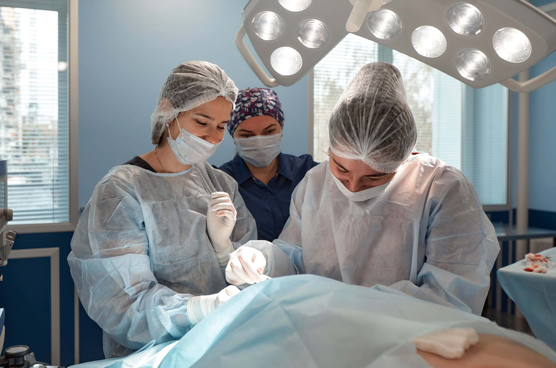
A surgical team at work in a hospital operating theatre
That last point shapes almost everything about male aesthetic surgery. Men’s faces and bodies differ from women’s in skin thickness, muscle mass, fat distribution and blood supply, and techniques designed with female patients in mind can produce results that look soft or overdone on a man. Understanding those differences helps men ask better questions at consultation and set realistic expectations.
Gynecomastia surgery
Enlarged breast tissue in men, known as gynecomastia, is one of the most common reasons men see a plastic surgeon. It can be caused by glandular tissue, fat, or a mixture of both. Hormonal shifts during puberty or later life, certain medications, anabolic steroid use, alcohol, and some medical conditions can all contribute, though in many men no single cause is found.
Treatment depends on what the tissue is made of. Mostly fatty enlargement may respond to liposuction alone. Firm glandular tissue needs to be removed through a small incision, usually along the lower edge of the areola, and most cases combine both techniques. Where there is a lot of loose skin, additional skin removal may be needed. A good surgeon also looks at the transition from chest to armpit and abdomen, so the result reads as a flat, masculine chest rather than a hollowed one.
Any underlying cause should be identified first; continued steroid use can bring the problem back.
See also: The Importance of Health in Everyday Life
Eyelid surgery
Blepharoplasty appeals to men told they look tired or stern. Upper eyelid surgery removes hooding skin; lower eyelid surgery treats under-eye bags. The male approach is usually more conservative: men tend to have a lower, flatter brow and a less defined eyelid crease, and an aggressive upper lid excision can make the eyes look surprised or feminised. Leaving a little natural fullness is often what keeps the result believable.
Liposuction and abdominal etching
Liposuction for men most often targets the flanks, lower abdomen, chest and under the chin. It is a contouring procedure rather than a weight-loss method, and it works best for men already close to their target weight whose stubborn areas have not responded to training.
Abdominal etching is a more specialised form of liposculpture that removes fat along the natural borders of the abdominal muscles to make them more visible. It suits lean men with a good muscular base; on someone carrying more fat or with weak muscle definition, the result can look artificial and becomes harder to maintain if weight changes. Honest surgeons will turn away men who are not suitable.
Rhinoplasty
Male rhinoplasty is usually about balance rather than reduction. A straight or slightly convex bridge, a tip that is not too upturned, and a nose that remains strong enough for the rest of the face are typical goals. Over-narrowing or over-rotating the tip is a common way a male nose ends up looking operated on. Many men also want breathing problems addressed at the same time, which can often be done in the same operation when the septum is involved.
Facelift and neck lift
A male facelift addresses jowls, loose neck skin and a blurred jawline. Several anatomical differences matter here. Men have thicker skin and a richer blood supply in the beard area, which brings a higher risk of bleeding under the skin after surgery, so blood pressure control is important. Incisions must be planned around the sideburns and beard so that hair-bearing skin is not pulled behind the ear, and the hairline cannot be relied on to hide scars the way it often can in women. The aim is a sharper, rested jawline, not a tight or smoothed one.
How male anatomy changes the plan
Across all of these procedures, a few principles tend to apply:
- Preserve angles. Strong jaw and brow lines are part of a male face, and rounding them off can look unnatural.
- Respect thicker skin. It drapes differently and swells for longer, which affects both technique and recovery expectations.
- Plan scars around hair. Beard, sideburns and short haircuts all limit where scars can be hidden.
- Avoid overcorrection. In both face and body, slight undercorrection usually looks more natural on men than the reverse.
Recovery, work and the gym
As a general guide, many men return to desk work within one to two weeks after gynecomastia surgery or liposuction, and around two to three weeks after a facelift. Compression garments are usually worn for several weeks after body procedures.
The gym is where men most often push too soon. Walking is encouraged early to reduce the risk of clots, and light cardio usually returns within a few weeks. Heavy lifting, particularly upper-body work after chest surgery, is commonly delayed for six to eight weeks to protect healing tissue and avoid fluid build-up. Following the surgeon’s timeline protects the result that the training is meant to show off.
Why more men are travelling for surgery
Cost is part of the reason: prices in some parts of Europe are substantially lower than in the UK, Germany or the US, and some providers bundle consultation, surgery, anaesthesia, hospital stay and follow-up into one price. Privacy is another: recovering away from home lets men return once obvious swelling has settled.
The trade-off is that follow-up is harder once the patient flies home, so the facility and planning matter more, not less. Men comparing options abroad tend to look at whether surgery takes place in a full hospital, what the surgeons’ training is, and how long they will need to stay. Departments such as Hygeia Plastic Surgery in Tirana, which runs a dedicated men’s programme covering gynecomastia, eyelid surgery, liposuction, abdominal etching, rhinoplasty and male facelift within a full hospital setting, typically offer an initial video consultation before any travel is booked. For many male procedures, a stay of around five to seven days is common, with longer stays for combined or more extensive surgery.
Wherever they are treated, men considering cosmetic surgery should talk through their goals, health and recovery plans with a qualified plastic surgeon before committing.