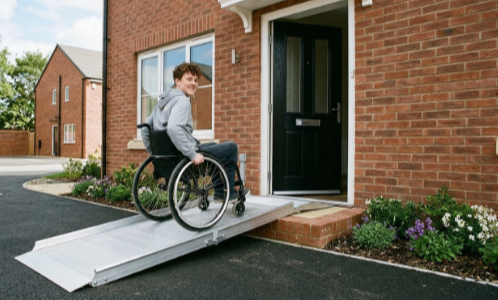
Where to Discover Wheelchair Ramps That Support Independent Living?

For seniors, caregivers, and anyone navigating mobility changes, a wheelchair ramp is often the single most impactful home upgrade you can make. It turns a barrier into a doorway, quite literally.
According to the Centers for Disease Control and Prevention (CDC), approximately 2 million wheelchair users live in the United States, and nearly 28.7 million older adults report some form of functional limitation that affects how they move through their homes and communities. For this population, access to practical mobility equipment is not a comfort issue. It is a quality-of-life issue.
This article is for anyone who wants to understand what wheelchair ramps are, why they matter for independent living, how to choose the right one, and where to find solutions that genuinely work.
Why Wheelchair Ramps Matter More Than People Realize
Most people do not think about ramps until they need one. But accessibility experts and occupational therapists consistently recommend planning for ramp access before a mobility limitation becomes a crisis.
Here is why that matters:
- Falls are the leading cause of injury among older adults. The CDC estimates that one in four adults over 65 falls every year. Steps and uneven thresholds are major contributing factors.
- Hospital discharge often happens before the home is ready. Many people return home after surgery or a health event to find that stairs and doorway steps have suddenly become serious obstacles.
- Caregivers face physical strain without ramps. Helping someone navigate a step in a wheelchair or walker puts both the caregiver and the person being helped at risk.
A well-placed ramp does not just improve safety. It restores confidence, reduces dependence on others for basic movement, and supports what aging and rehabilitation specialists call “aging in place,” meaning living in your own home for as long as possible.
Key Takeaways Before You Start Shopping
Before exploring wheelchair ramp options, keep these foundational points in mind:
- Rise height determines ramp length. The standard accessibility guideline (including ADA recommendations) is a 1:12 slope ratio. This means for every 1 inch of vertical rise, you need 12 inches of ramp length. A 6-inch step requires at least a 6-foot ramp.
- Weight capacity matters. Ramps have rated load limits. Always factor in the weight of the user plus any mobility equipment.
- Portability versus permanence. Some situations call for a fixed ramp at a home entrance. Others call for a portable ramp that can travel with the person. Your daily routine shapes which type makes sense.
- Surface grip is non-negotiable. A ramp without a textured, non-slip surface is dangerous in wet or cold weather.
Types of Wheelchair Ramps: What Are Your Options?
Understanding the main ramp types helps you make a smarter decision for your specific situation.
Telescopic Portable Ramps
These are one of the most practical options for everyday mobility. A telescopic ramp extends and retracts, adjusting to different heights and situations. You can use it at a car trunk, a friend’s front steps, a store entrance, or a home threshold. When you are done, it folds or slides down into a carry bag.
If you are a caregiver managing daily transportation, or a wheelchair user who travels and visits different environments, a telescopic ramp offers flexibility that a fixed ramp simply cannot match.
For anyone ready to take that next step, explore Whlicks ramps here to see adjustable, aluminum telescopic options rated for up to 600 lbs, with anti-slip surfaces and storage bags included.
Folding Ramps
Folding ramps collapse in half for storage and transport. They tend to be wider than telescopic models, which makes them a good choice for electric wheelchairs or power scooters that need more clearance. They are less compact than telescopic ramps but often easier to set up as a semi-permanent solution at a single location.
Threshold Ramps
These are small, wedge-shaped ramps designed to bridge minor height differences, such as a raised door threshold, a bathroom lip, or a low curb. They are inexpensive, lightweight, and useful in situations where the rise is minimal (typically under three inches). Many families use them alongside a larger portable ramp for full home accessibility coverage.
Permanent Modular and Concrete Ramps
For individuals who need daily, high-traffic ramp access at a fixed location, a permanent ramp may be the right long-term investment. Aluminum modular ramps can be installed without concrete work and adjusted over time. Concrete ramps are the most durable but require professional installation and, in many areas, a building permit.
Choosing the Right Wheelchair for Ramp Use
A ramp is only as useful as the wheelchair or mobility aid it works with. The two pieces of equipment need to work together, not against each other.
Here are the main wheelchair types and how they interact with ramps:
| Wheelchair Type | Best For | Ramp Consideration |
| Manual self-propelled | Independent users with upper body strength | Works well on moderate slopes |
| Transport chair | Caregiver-assisted mobility | Lighter weight helps on inclines |
| Foldable lightweight chair | Travel and outings | Easier to load with portable ramps |
| Electric/motorized chair | Users with limited arm or hand strength | Needs wider, higher-capacity ramps |
If you are evaluating both ramps and wheelchairs together, it helps to look at them as a system. Check Whlicks for more options here to see manual, transport, and foldable options designed for everyday mobility, travel, and caregiver-assisted use.
Choosing a wheelchair and a compatible ramp at the same time ensures that the weight capacity, width, and slope requirements all align before you make a purchase.
Real-World Scenarios: Who Needs a Wheelchair Ramp?
It helps to see this through real situations people face every day.
Scenario 1: Post-surgery recovery at home A person returns home after hip replacement surgery using a transport wheelchair. Their front entrance has a three-step stair. A portable telescopic ramp, set up by a family member, allows them to enter and exit safely without assistance from a second person at every threshold.
Scenario 2: A senior aging in place An 80-year-old woman uses a rollator walker most of the time but has a manual wheelchair for longer outings. Her home has one step at the side entrance. A threshold ramp handles that barrier, and a folding ramp stays in her daughter’s car for appointments and visits.
Scenario 3: A caregiver managing daily transportation A caregiver assists a mobility-limited parent five days a week. Loading a transport wheelchair into an SUV is physically taxing without a ramp. A lightweight telescopic ramp, stowed in the trunk, reduces the strain on the caregiver and makes the process safer for both people.
In each of these cases, the ramp is not a luxury. It is part of a functional daily routine.
What to Look for in a Quality Ramp
When evaluating any wheelchair ramp, ask these questions before buying:
- What is the weight capacity? Look for at least 600 lbs to accommodate most wheelchair and user combinations with a safety margin.
- Is the surface non-slip? Frosted or textured aluminum surfaces provide grip in wet conditions.
- How does it store and transport? A carry bag makes storage practical. A compact folded profile fits in most vehicles.
- Is it adjustable? Telescopic designs that accommodate multiple lengths are far more versatile than fixed-length ramps.
- How quickly can it be deployed? For daily use, a ramp that takes more than two minutes to set up is a friction point. Button-lock telescopic mechanisms set up in seconds.
- Is it compatible with your mobility equipment? Check the width clearance against your wheelchair’s total width, including the wheels.
The Connection Between Ramps and Mental Wellbeing
This point is often overlooked in conversations about mobility equipment.
Independence is deeply connected to self-esteem and mental health. Research published in journals focused on aging and rehabilitation consistently shows that mobility limitations which restrict a person’s ability to leave their home correlate with increased rates of depression, social isolation, and anxiety.
A ramp that allows someone to walk out their front door on their own terms is not just a safety feature. It is a dignity-preserving one. Occupational therapists who work with seniors and people with disabilities frequently cite accessible entryways as among the first and most important home modifications to address.
Frequently Asked Questions
What slope ratio is safe for a wheelchair ramp?
The widely accepted standard is a 1:12 ratio, meaning 1 inch of rise for every 12 inches of ramp length. For users who self-propel, a gentler slope such as 1:16 or 1:20 is easier to manage. For caregiver-assisted transport chairs, the 1:12 ratio is generally sufficient.
How much weight can a portable wheelchair ramp hold?
Quality aluminum portable ramps are typically rated for 600 lbs. Always confirm the rated capacity of any ramp before purchasing, and factor in the combined weight of the user and the wheelchair or mobility device.
Can I use a wheelchair ramp for a walker or rollator?
Yes. Most wheelchair ramps work equally well for walkers, rollators, and even mobility scooters. A telescopic ramp is especially versatile because it works across many types of mobility equipment and different height situations.
Do I need a permit to install a wheelchair ramp at home?
For temporary or portable ramps, no permit is typically required. For permanent, structural ramps, permit requirements vary by city and state. It is worth checking with your local building department before starting any fixed installation.
How do I know which wheelchair is right for me or my loved one?
The right wheelchair depends on several factors: whether the user self-propels or needs caregiver assistance, daily usage distance, portability requirements, and weight capacity needs. An occupational therapist can provide a formal assessment, and many mobility equipment providers offer helpful guidance during the selection process.
A Final Note
Mobility support is not a one-size-fits-all situation. The right combination of a quality ramp and a well-matched wheelchair or mobility device can make an enormous difference in daily life, both practically and emotionally.
Start by assessing the barriers in your specific environment. Measure your rise heights. Think about where the mobility equipment will be used most often, at home, in vehicles, or while traveling. Then look for equipment that matches those real-world conditions rather than buying for the most common case.
Independent living is possible for most people with the right support in place. A good wheelchair ramp is one of the most direct, affordable steps toward making that happen.