Soil Anchors for Retaining Walls and Slopes: A Practical Guide

A retaining wall holds back tonnes of earth, and a slope can move slowly for years before anyone notices. In both cases, the ground itself needs help to stay put. Soil anchors are steel tendons installed into the ground behind a wall or slope, tensioned and locked off, so they pull the structure back into the earth it is holding. They are a proven way to stabilise ground without rebuilding the wall or regrading the whole slope. This guide explains how soil anchors work, where they are used and what a successful installation looks like.
What Soil Anchors Do
Soil anchors, sometimes called ground anchors or earth anchors, are long steel bars or strands grouted into a drilled hole in the ground. One end is bonded deep in stable soil or rock, and the other end is attached to the wall, slope facing or structure that needs support. Once the anchor is tensioned, it pulls the wall towards the stable ground behind it, resisting the pressure of the soil in front.
The principle is straightforward: instead of making the wall thicker and heavier to resist the earth, soil anchors borrow strength from the ground behind the wall. That makes them useful where space is limited, where a wall is already built and showing signs of movement, and where a slope needs stabilising without major excavation.
How Soil Anchors Are Installed
Installation starts with drilling. A hole is bored through the wall or slope face at a downward angle, usually between 10 and 30 degrees below horizontal, reaching into the stable ground beyond the zone that is moving. The steel tendon, often a bar or a bundle of strands, is inserted into the hole, and the far end, the bond length, is grouted in place.
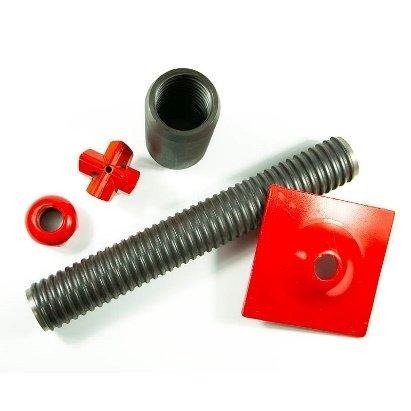
After the grout cures, the anchor is tensioned with a hydraulic jack, pulling the tendon tight against the wall, and then locked off with a nut or wedge plate. The tension is checked against the design, and the anchor head is protected with a cap and grout or a cover. Each anchor is installed and tested in turn, so the wall is supported progressively rather than all at once.
Retaining Walls: Repair and New Build
Soil anchors are widely used to repair retaining walls that have started to lean or crack. Rather than demolishing and rebuilding the wall, anchors can be installed through the existing structure and tensioned to pull it back and hold it. This is often faster and cheaper than a rebuild, and it avoids the disruption of excavating behind the wall.
For new walls, soil anchors allow a slimmer design. A wall that would otherwise need a thick, heavy base can be built thinner when anchors carry part of the load. That saves concrete, reduces excavation and can make a project possible on a tight site where a massive gravity wall would not fit.
Stabilising Slopes and Embankments
Slopes fail when the forces pulling material downhill overcome the strength of the soil. Soil anchors counter that by tying the surface layers back into stable ground deeper in the slope. They are often used with a facing system, such as shotcrete, mesh or planted geotextiles, which holds the surface together while the anchors carry the load.
Highway and railway embankments, cuttings and natural slopes above buildings are common applications. Because the work is done from the face of the slope, with drilling rigs that can work on steep ground, stabilisation is possible without regrading the whole slope or closing the road below for long.
Design: Getting the Numbers Right
Soil anchors are engineered, not guessed. A geotechnical engineer studies the ground, usually from boreholes and soil tests, and designs the anchor layout: the length, angle, spacing and load for each anchor. The bond length must sit in stable ground beyond the slip surface, and the anchor must be sized with a safety margin for the loads it will carry.
Proof testing is part of the process. A proportion of the anchors are loaded beyond their working load to confirm the ground can hold them, and the results are recorded. If an anchor fails its test, the design is adjusted, perhaps with a longer bond length or a different position. This testing is what gives the client confidence that the slope or wall will stay put.
5 Signs a Wall or Slope Needs Attention
- Leaning or bulging: the wall face moves forward or bows outwards.
- Cracking: horizontal or stepped cracks appear in the wall or the ground behind it.
- Tilting: fence posts, trees or structures near the edge start to lean.
- Water problems: springs or wet patches appear at the base of the slope.
- Falling material: small slips or debris collect at the foot of the slope.
Any of these signs deserves a professional inspection before the problem grows.
Frequently Asked Questions
How long do soil anchors last?
Properly designed and protected anchors last for decades. The tendon is grouted and the head is sealed against corrosion, and the anchors can be inspected and re-tensioned if needed.
Can soil anchors be installed without closing a road?
Often, yes. The work is done from the face of the wall or slope, and traffic management is usually limited to a lane closure or a short working window.
Do soil anchors work in all ground?
They suit most soils and weathered rock, provided the bond length reaches stable ground. Very soft or loose ground may need longer anchors or a different approach, which the ground investigation will reveal.
Final Thoughts
Soil anchors turn the ground behind a wall or slope into part of the structure, holding it back with tension rather than weight. They repair leaning walls, slim down new ones and stabilise slopes with far less disruption than rebuilding. With a proper ground investigation, a sound design and proof testing, they give a lasting answer to one of the oldest problems in construction: keeping the earth where it belongs.