Dental Medical Billing in 2027: Which Procedures Qualify and How to Get Paid

Most dental practices send every claim to dental insurance, even when the treatment is medical. A sleep apnea appliance, a TMJ splint or a biopsy of a suspicious lesion can often be billed to the patient’s medical plan, where dental annual maximums do not apply. Getting paid takes a different code set, a different claim form and payer enrollment, built in-house or handled by a medical billing company that works on both sides.
What Is Dental Medical Billing?
Dental medical billing is the process of sending a dental procedure to the patient’s medical insurance instead of their dental plan, because the treatment addresses a medical condition. It is a separate job from routine dental insurance billing, which is why many practices use dental medical billing services rather than their front desk to run it. The dentist still records the visit in CDT, but the claim to the medical plan goes out with CPT or HCPCS procedure codes and ICD-10-CM diagnosis codes. Medical necessity, not the dental benefit, decides whether it pays.
Dental medical billing vs dental insurance billing
Dental insurance billing sends CDT codes to a dental plan on the ADA Dental Claim Form or its electronic version, the 837D. Dental medical billing sends a claim to a medical payer on the CMS-1500 or its electronic version, the 837P. The payer is different, the form is different and the code set is different. A practice can do both for the same patient, and often should.
Why most practices never pursue this revenue
The barrier is rarely clinical. Most dentists already treat sleep apnea, jaw pain and oral lesions. What stops them is the setup. A practice has to enroll with medical payers, route claims through a clearinghouse that handles 837P files and document visits the way a medical reviewer expects. Without that groundwork, the first medical claim never leaves the building.
Dental Billing vs Medical Billing: Five Operational Differences
Dental and medical billing look alike from the outside. Both turn a visit into a claim. Under the surface they run on different rules, and those rules decide who pays and how much. The table below shows the five differences that matter most when a dental office starts billing medical plans.
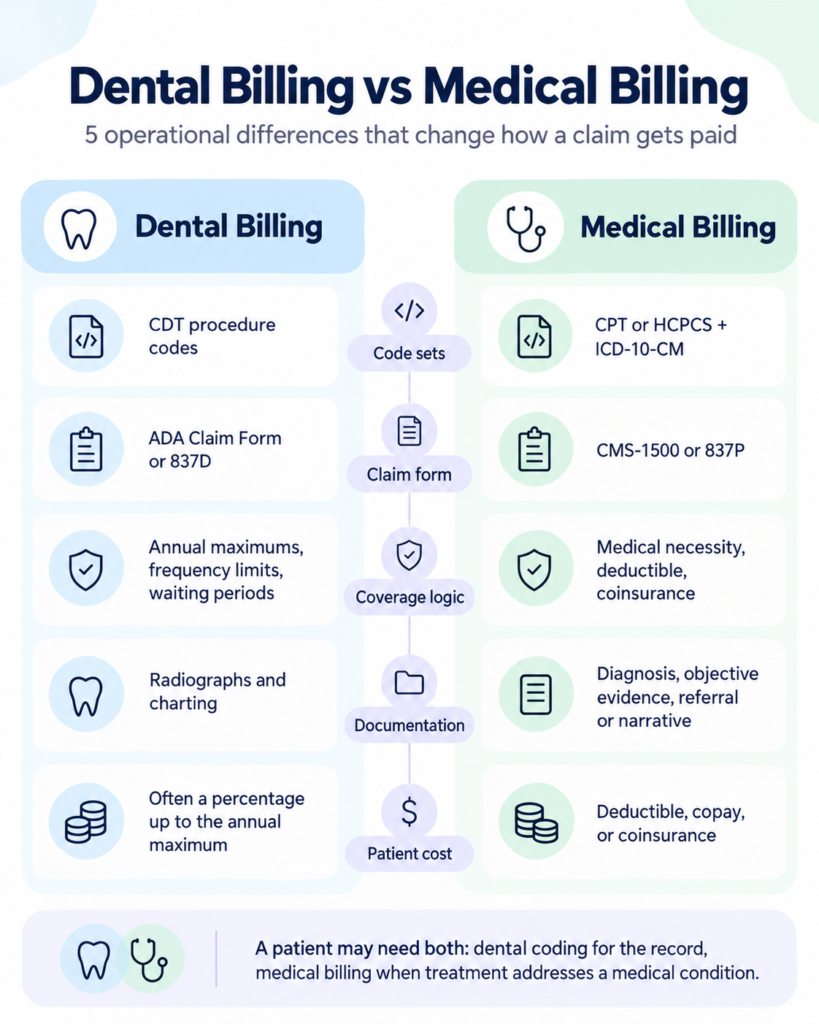
| Area | Dental Billing | Medical Billing |
|---|---|---|
| Code sets | CDT procedure codes from the ADA | CPT and HCPCS procedure codes with ICD-10-CM diagnoses |
| Claim form | ADA Dental Claim Form or 837D | CMS-1500 or 837P |
| Coverage logic | Annual maximums, frequency limits and waiting periods | Medical necessity tied to a diagnosis, plus deductibles and coinsurance |
| Documentation | Radiographs and periodontal charting when the plan asks | Diagnosis, objective evidence and often a physician referral or narrative |
| Patient cost | Usually a percentage up to the annual maximum | Deductible, copay or coinsurance up to the plan’s out-of-pocket limit |
Code sets: CDT against CPT, ICD-10 and HCPCS
CDT, maintained by the American Dental Association, describes dental procedures. Medical payers expect CPT for procedures, HCPCS Level II for items such as devices and ICD-10-CM for the diagnosis. Dental claims rarely need a diagnosis code. Medical claims never go without one.
Claim forms: ADA dental claim form against CMS-1500
A medical payer will not process an ADA Dental Claim Form. Medical claims go out on the CMS-1500, or electronically as an 837P, with the rendering provider’s NPI, the place of service and a diagnosis pointer on every line.
Coverage logic: annual maximums against medical necessity
Annual maximums are a dental plan feature. Most dental plans stop paying once the yearly cap is reached, which is why expensive treatment exhausts them fast. Medical plans have no dental annual maximum. They pay when the service is medically necessary and covered by the policy, after the patient’s deductible and cost sharing.
Documentation and attachment requirements
Dental plans mostly want radiographs or charting for specific procedures. Medical payers want proof of a medical problem: a diagnosis, test results such as a sleep study or pathology report and notes that link the treatment to that problem.
Reimbursement models and patient cost exposure
Dental plans often pay a set percentage by procedure category. Medical plans pay against a contracted fee schedule, and the patient owes the deductible and coinsurance. For a high-cost appliance or surgery, that difference can decide whether a patient goes ahead with treatment.
Which Dental Procedures Qualify for Medical Billing?
A procedure qualifies when it treats a medical condition, not when it is simply expensive. The diagnosis has to be medical, the treatment has to address it and the patient’s medical policy has to cover it. These are the procedure families that most often pass that test.
Obstructive sleep apnea oral appliance therapy
Obstructive sleep apnea (G47.33) is a medical diagnosis, so a custom oral appliance belongs on the medical claim. The appliance is billed with HCPCS E0486 rather than the dental code D9947. A physician must diagnose sleep apnea from a sleep test, because dentists cannot. For Medicare, the appliance must meet LCD L33611, and the dentist must enroll as a DMEPOS supplier with a written order from the treating physician.
TMJ and orofacial pain treatment
Temporomandibular joint disorders (M26.60 codes, with laterality) are medical conditions, so evaluation and many treatments can go to the medical plan. Coverage varies a lot, and some medical policies exclude TMJ care entirely. CDT 2027 adds codes for orofacial pain care, including trigger-point injections and nerve blocks, which already have CPT codes on the medical side.
Oral surgery following trauma
A fall, a car accident or a sports injury that damages teeth or the jaw is a medical event. Bill the medical plan first, record the injury diagnosis and the date and cause of the accident and keep the dental plan as secondary. Auto or liability coverage may come before both.
Biopsies and oral pathology
A biopsy of a suspicious lesion is diagnostic work for a possible medical disease. Medical claims use site-specific CPT codes, such as 40808 for the vestibule or 41100 for the tongue. Medicare also covers medical procedures that dentists are licensed to perform, including biopsies for oral cancer.
Bone grafts and implants in reconstructive cases
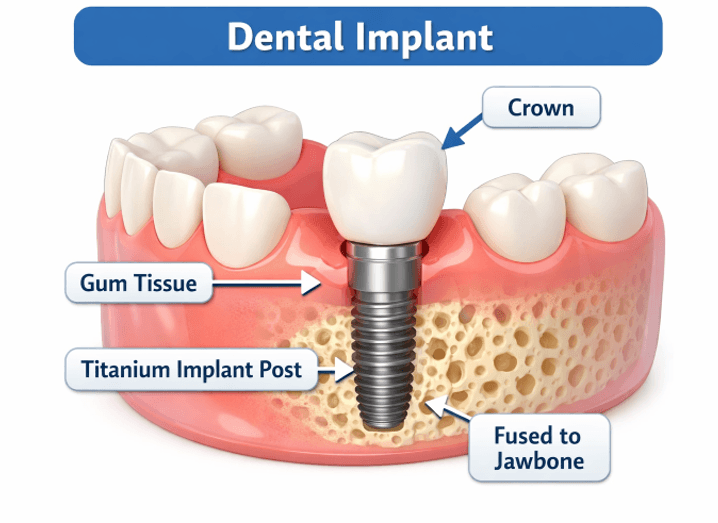
Bone grafting and implants can qualify when they rebuild the jaw after trauma, tumor removal or a congenital defect. The medical record must show the reconstructive purpose. Routine implant placement to replace a missing tooth does not qualify. Medical payers treat that as a dental service, and the claim will be denied.
Procedures that almost never qualify
Being clear about what stays dental saves a practice from claims that were never going to pay. These procedures almost always belong on the dental claim:
- Cleanings, exams and X-rays done for routine dental care
- Fillings, root canals and crowns for decay
- Routine extractions with no linked medical condition
- Implants placed only to replace a missing tooth
- Cosmetic work such as whitening and veneers
- Snoring appliances without a sleep apnea diagnosis
What Medicare covers and what it does not
Medicare does not cover routine dental care. It does pay for dental services that are inextricably linked to certain covered treatments, such as a dental exam and infection treatment before an organ transplant or cardiac valve replacement, care linked to head and neck cancer treatment and an exam before dialysis for end-stage renal disease. These claims use CDT codes on the 837D, and MACs ask for modifier KX to flag the link. The dentist must be enrolled in Medicare.
The CDT to CPT Crosswalk: How Cross-Coding Works
Cross-coding means taking the procedure you documented in CDT and reporting it to a medical payer with the matching CPT or HCPCS code and a supporting ICD-10-CM diagnosis. Some procedures have a clean match. Others have none. The table shows common pairs, but payer policies differ, so confirm each payer’s rules before you bill.
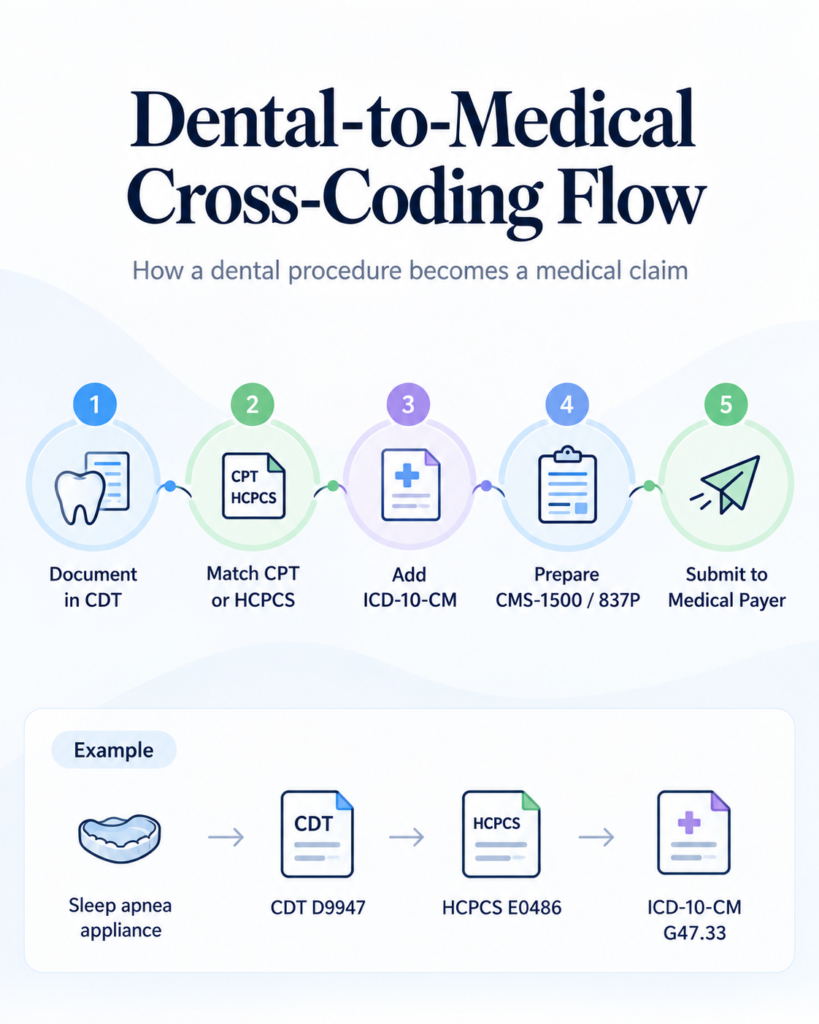
Crosswalk reference table
| Procedure | CDT 2027 | CPT or HCPCS | Example ICD-10-CM |
|---|---|---|---|
| Evaluation of a medical problem | D0140, D0150 or D0160 | E/M 99202-99215, level set by decision making or time | Per condition, such as G47.33 |
| Panoramic image | D0330 | 70355 | Per finding, such as D16.5 |
| Cone beam CT | D0367 | 70486, or the CT code the payer specifies | Per finding, such as D16.5 |
| Custom sleep apnea appliance | D9947 | E0486 | G47.33 |
| TMJ occlusal orthotic | D7880 | No consistent match; payer-specific or unlisted with a narrative | M26.60 code with laterality |
| Orofacial pain injections | New CDT 2027 codes | 20552 or 20553 (trigger points), 64405 (greater occipital nerve), 64505 (sphenopalatine ganglion) | M79.11 |
| Incisional biopsy of oral tissue | D7285 (hard) or D7286 (soft) | Site-specific: 40490 lip, 40808 vestibule, 41100 tongue, 41108 floor of mouth | K13.21 |
| Reimplanting a tooth after trauma | D7270 | 41899 (unlisted dentoalveolar) with a narrative | S03.2XXA plus an external cause code |
| Bone graft in jaw reconstruction | D7950 | 21210 (maxilla) or 21215 (mandible) | D16.5 or a jaw fracture code |
| Extraction before a transplant (Medicare) | D7140 | Billed as D7140 on the 837D with modifier KX | Z76.82 |
When no direct CPT equivalent exists
Some dental procedures have no CPT match. In that case the claim uses an unlisted procedure code, such as 41899 for dentoalveolar structures, with a short narrative report. The narrative explains what was done, why it was medically necessary and which listed CPT code it most resembles for pricing. Expect these claims to go to manual review, so send the records with the first submission.
Billing medical primary and dental secondary
When a procedure qualifies, the medical plan is usually primary. Submit to medical first, wait for the explanation of benefits and then send the dental claim with the medical payment attached. The dental plan can then pick up part of what medical did not pay, up to its own limits. Sending dental first often leads to a denial asking for the medical decision.
Proving Medical Necessity: The Documentation Standard
Medical necessity is the reason a medical payer pays. Most cross-coded claims that fail do so here, not because the code was wrong. A medical reviewer reads your notes looking for a medical problem and proof that your treatment addresses it.
The four-point medical necessity test
Run each case through these four checks before you bill medical:
- There is a medical diagnosis, coded in ICD-10-CM, not a dental one such as caries.
- The treatment addresses that diagnosis or the function it affects, such as breathing, chewing or jaw movement.
- Objective evidence supports it, such as a sleep study, imaging or a pathology report.
- The case meets the payer’s written medical policy, including any required referral or prior authorization.
If any of the four is missing, fix the record before the claim goes out or keep the procedure on the dental claim.
Physician referral and diagnostic evidence
Many medical payers want a physician in the loop. For sleep apnea, that means a sleep study read by a physician and an order for the appliance. For trauma, it can mean emergency room records. For a lesion, the pathology report closes the case. Keep these documents in the chart before you submit.
What belongs in the narrative report
- The patient’s symptoms and how long they have lasted
- The diagnosis and the test or exam that confirmed it
- Treatments already tried and why they were not enough
- What you did and how it treats the medical problem
- The expected result and the follow-up plan
What a Practice Needs Before It Can Bill Medical at All
This is the step most guides skip. Before a dental office can send one medical claim, it needs payer enrollment, a way to send 837P claims and staff who can read the results. Missing any of these stops the process at the start.
NPI and medical payer enrollment
A dentist does not need a separate medical NPI. Each provider gets one NPI for every health plan, dental and medical alike. What the practice needs is enrollment with each medical payer it plans to bill. For Medicare, that means enrolling as a provider, and appliance billing also requires DMEPOS supplier enrollment. Commercial medical plans require their own credentialing and contracts. Plan for this through medical payer credentialing months before the first claim.
Medical clearinghouse and CMS-1500 capability
Many dental clearinghouses are set up for 837D files only. Check that yours can send 837P claims to medical payers and return medical remittances. If it cannot, you will need a medical clearinghouse connection. Your practice software also needs to hold CPT, HCPCS and ICD-10-CM codes and print a CMS-1500.
Team capability: train or outsource
Someone on the team has to code medical claims, read remittance advice and work denials. That is a different skill set from dental billing. A practice can train a coordinator or outsource the medical side. The right choice depends on how many medical cases you see, which section 9 covers.
The Dental Medical Billing Process, Step by Step
Once the setup is in place, every medical claim follows the same path. Each stage has its own checks, and skipping one usually shows up as a denial weeks later.
Before treatment: verification and preauthorization
- Collect both the medical and dental insurance cards at intake.
- Run dental insurance verification and medical eligibility checks to confirm active coverage and which plan is primary.
- Check the medical policy for the procedure and any referral rules.
- Request prior authorization and get the approval number in writing.
- Explain expected patient costs before treatment begins.
At treatment: coding and documentation capture
- Record the visit in CDT for your dental records.
- Document the medical diagnosis, symptoms and objective findings.
- Attach test results, referrals and imaging to the chart.
- Select the CPT or HCPCS code and link each line to an ICD-10-CM diagnosis.
- Write the narrative report when the payer or an unlisted code calls for one.
After treatment: submission, posting and appeals
- Send the claim on the 837P or CMS-1500 to the medical payer.
- Track it until it is accepted, not just sent.
- Post the payment and read every adjustment on the remittance.
- Send the secondary claim to the dental plan with the medical EOB.
- Work denials and file appeals within the payer’s deadline.
Why Dental-to-Medical Claims Get Denied
Cross-coded claims fail for a small set of reasons, and most of them start before the claim is sent. Knowing the pattern lets you fix the process instead of fixing claims one at a time.
The five most common denial reasons
| Reason | Root Cause | Fix |
|---|---|---|
| Medical necessity not shown | Notes read like dental notes with no medical diagnosis or evidence | Lead with the diagnosis, attach test results and add a narrative |
| Dental codes sent to a medical payer | CDT codes on a claim to a plan that only accepts CPT and HCPCS | Cross-code before submission, except where Medicare dental rules call for CDT |
| Provider not enrolled | Dentist not credentialed with the medical plan or not enrolled with Medicare | Finish enrollment before treating that payer’s patients |
| No prior authorization | Appliance delivered or surgery done before approval | Get written approval and record the number on the claim |
| Wrong form or wrong order | ADA form sent to medical, or dental billed first | Use the CMS-1500 or 837P and bill medical as primary |
How to appeal a denied cross-coded claim
- Treat each denial as a case, the way denial management for medical claims works in any physician practice, and start by reading the reason code.
- Decide if it is a fixable error, such as a missing modifier, and send a corrected claim instead of an appeal.
- Gather the evidence the payer did not see, such as the sleep study, imaging or pathology report.
- Write a short letter that ties the diagnosis to the procedure and quotes the payer’s own policy.
- File within the payer’s appeal deadline and keep proof of the date sent.
- Track the appeal and move to the next level if the first review upholds the denial.
In-House or Outsourced: Which Fits Your Practice
There is no single right answer. The choice depends on how many medical cases you see, who on your team can learn medical coding and how much setup work you can absorb. The table compares the two paths on the points that usually decide it.
| Factor | In-House | Outsourced |
|---|---|---|
| Setup | Practice handles payer enrollment and clearinghouse changes | Partner handles setup, often including credentialing |
| Knowledge | Staff must learn CPT, ICD-10-CM and medical policies | Team already codes and appeals medical claims |
| Cost | Salary, training and software | Usually a percentage of collections |
| Control | Direct oversight of every claim | Visibility through reports and an account contact |
| Best fit | Steady medical volume and a coordinator with time to learn | Low or growing medical volume, or no in-house medical expertise |
When in-house billing works
In-house billing makes sense when medical cases are a regular part of the schedule, such as a practice with an active sleep or TMJ program. It also works when a coordinator has time to learn medical coding and keep up with payer policy changes. The practice keeps full control and builds the skill inside the business.
When outsourcing is the better economics
Outsourcing tends to win when medical cases are occasional, when nobody on staff knows medical coding or when enrollment has not started. Paying a percentage of what is collected can cost less than training staff for a few claims a month. It also brings appealing experience the practice would otherwise learn the hard way.
How iSolve RCM Helps Dental Practices Bill Medical Insurance
iSolve RCM runs the medical side of dental billing so your team can keep the dental side moving. We start where most practices stall: enrolling your dentists with medical payers and Medicare, including the setup your practice needs before the first claim.
From there, our team verifies medical and dental coverage before treatment, requests prior authorization, cross-codes each case into CPT, HCPCS and ICD-10-CM and sends clean CMS-1500 claims to the medical payer. We follow every claim to payment, file appeals when a denial comes back and send the secondary claim to the dental plan once medical has paid.
Pricing starts as low as 2.99% of monthly collections. If you are not sure your cases qualify, we will review them with you first.

Dental Medical Billing FAQs
Can a dentist bill medical insurance?
Yes. A dentist can bill medical insurance for procedures that treat a medical condition, such as a sleep apnea appliance, TMJ care or a biopsy. The procedure has to meet the payer’s medical necessity rules, and the dentist has to be enrolled or credentialed with that medical payer. Routine dental care still goes to the dental plan.
What dental procedures does medical insurance cover?
Medical insurance most often covers oral appliances for obstructive sleep apnea, TMJ and orofacial pain treatment, oral surgery after trauma, biopsies and some reconstructive bone grafting. Coverage depends on the diagnosis, the documentation and each plan’s medical policy. Routine cleanings, fillings and cosmetic work almost never qualify. The section on qualifying procedures above walks through each family.
What is dental to medical cross-coding?
Cross-coding is translating a dental procedure documented in CDT into the CPT or HCPCS code a medical payer accepts, paired with an ICD-10-CM diagnosis. The claim then goes on a CMS-1500 or 837P instead of the ADA Dental Claim Form. Some procedures have a direct match, while others need an unlisted code with a narrative report.
Is a dental bill considered a medical bill?
No. Dental and medical bills go to separate plans with separate policies and separate payers. The narrow exception is a dental procedure that treats a medical condition. When it meets medical necessity, it can be billed to the medical plan on a medical claim form, with the dental plan as secondary.
Does Medicare cover dental procedures?
Generally not for routine dental care. Medicare pays for dental services that are inextricably linked to certain covered treatments, such as dental work before an organ transplant or cardiac valve replacement, care linked to head and neck cancer treatment and an exam before dialysis. It also covers medical procedures dentists perform, such as oral cancer biopsies. The dentist must be enrolled in Medicare.
Do I need a medical NPI to bill medical insurance?
No separate NPI is needed. A dentist uses one NPI for every health plan, dental and medical. What you do need is enrollment with each medical payer you bill, Medicare enrollment for Medicare patients and DMEPOS supplier enrollment to bill Medicare for sleep apnea appliances. You also need a clearinghouse that can send 837P claims.
Why do medical claims from dental offices get denied?
The biggest cause is documentation that does not prove medical necessity. Other common causes are CDT codes sent to a payer that only accepts CPT and HCPCS, a dentist who is not enrolled with the payer, missing prior authorization and a claim sent on the wrong form or to the wrong payer first. The denial section above shows the fix for each.
Should I bill medical or dental insurance first?
Bill medical first when the procedure qualifies. The medical plan is usually primary for medically necessary care. Once medical pays or denies, send the dental claim with the medical explanation of benefits attached. The dental plan can then cover part of the balance, up to its own limits and annual maximum.
How long does a dental medical claim take to pay?
For Medicare, a clean electronic claim cannot be paid before day 14 and should be paid within 30 days, under the Medicare payment floor rules. Commercial plans follow their contracts and state prompt-pay laws. Prior authorization, requests for records and appeals all add time, and claims with unlisted codes usually take longer because they go to manual review.