
How Australian Universities Are Preparing Students for Future Healthcare Careers

The healthcare landscape is undergoing an unprecedented transformation. Driven by rapid technological advancements, shifting demographic demands, an aging population, and a heightened focus on preventative care, the industry is evolving faster than ever before. For high school students and undergraduate aspirants looking toward a career in medicine, nursing, allied health, or biomedical science, this dynamic landscape offers incredible opportunities—but it also demands an entirely new kind of preparation.
Australian higher education institutions are recognized globally for their forward-thinking approaches to medical and health sciences education. By moving beyond traditional rote learning and embracing immersive technologies, interdisciplinary frameworks, and robust industry partnerships, universities across Australia are reshaping how future healthcare professionals are trained.
This comprehensive guide explores how Australian universities are equipping the next generation of healthcare professionals to succeed in a rapidly evolving workforce, what institutional changes are reshaping the student experience, and what prospective students need to know to navigate this exciting academic path.
The Changing Paradigm of Healthcare in Australia
To understand how universities are adapting, it is essential to look at the macroeconomic and systemic forces driving change within the Australian healthcare system. Government frameworks, such as the National Health Capability Framework, alongside state-level operational health initiatives, are increasingly prioritizing digital literacy, mental health integration, and community-based, preventative care models over traditional reactive hospitalization.
Future healthcare professionals will no longer operate in isolated silos. The modern Australian clinical environment demands radical integration. A registered nurse, a physiotherapist, a digital health analyst, a pharmacist, and a general practitioner will routinely collaborate within integrated care teams, heavily relying on real-time data, shared digital health records, and artificial intelligence to optimize patient outcomes.
Consequently, Australian universities have shifted their educational philosophy from purely clinical competence to holistic, adaptive expertise. They are building professionals who are not just experts in human anatomy, but experts in collaborative systems. To manage this rigorous shift, many students utilize Myassignmenthelp to balance their demanding clinical placements with complex theoretical coursework.
1. Immersive Technologies and Simulation-Based Learning
One of the most visible changes in Australian health science faculties is the departure from traditional lecture-heavy curricula in favor of high-fidelity simulation and immersive technology. The days of learning complex clinical procedures purely from a static textbook or blackboard are gone.
Virtual Reality (VR) and Augmented Reality (AR)
Institutions like the University of Sydney, Monash University, and the University of Queensland have integrated advanced VR and AR platforms directly into their anatomy and clinical skills labs. For instance, instead of relying solely on physical cadavers or 2D diagrams, undergraduate students can don VR headsets to navigate a 3D holographic projection of the human cardiovascular system.
Students can isolate specific arteries, view pathologically damaged heart valves in real-time motion, and simulate intricate surgical procedures. This allows students to practice diagnostic skills in a zero-risk environment where mistakes become valuable learning opportunities rather than critical clinical events.
High-Fidelity Simulation Wards
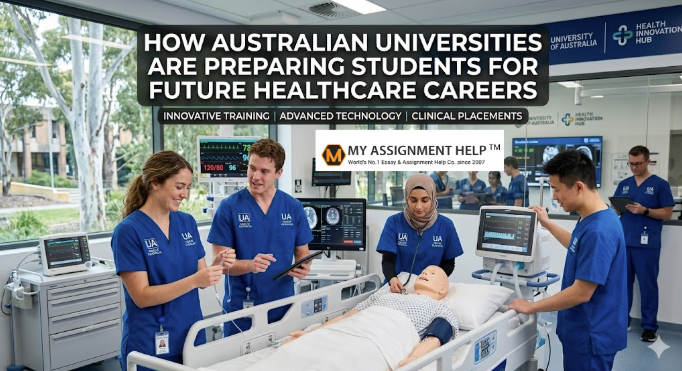
Modern nursing, midwifery, and paramedicine programs across Australia utilize simulated hospital environments that mirror state-of-the-art intensive care units (ICUs) and emergency departments. These spaces are equipped with computerized, high-fidelity mannequins that possess stunningly realistic human physiological responses. These advanced mannequins can breathe, blink, sweat, speak, pass fluids, and even go into sudden cardiac arrest or exhibit rapidly changing vital signs in response to a student’s chosen medical intervention.
Through these high-stakes simulated scenarios, students learn to manage intense, high-pressure situations—such as a critical ICU admission or an emergency obstetric complication—long before they step into a real hospital ward. This pedagogical shift builds immense clinical confidence and ensures that patient safety remains paramount during the initial phases of clinical training.
2. Emphasizing Interprofessional Education (IPE)
In a real-world healthcare setting, patient care is fundamentally a team sport. Recognizing that communication breakdown is historically a leading cause of clinical errors worldwide, Australian higher education institutions have pioneered structured Interprofessional Education (IPE) frameworks.
IPE brings together students from diverse health disciplines—including medicine, nursing, pharmacy, physiotherapy, social work, and occupational therapy—to learn with, from, and about each other throughout their academic journeys. Notably, this shift toward cross-functional, project-based learning isn’t unique to medicine; technical faculties facing similar industry transformations frequently offer specialized civil engineering assignment help to help students navigate the complex logistics of multi-disciplinary infrastructure and healthcare facility design projects.
| Traditional Healthcare Training | Modern Australian IPE Approach |
| Disciplines trained in strict professional isolation | Cross-disciplinary joint workshops, labs, and seminars |
| Fragmented, single-lens understanding of patient care | Shared, multi-disciplinary case-study analysis from day one |
| Hierarchical, top-down communication models | Emphasis on collaborative leadership and mutual respect |
Throughout their undergraduate degrees, students participate in joint case-study analyses, mock grand rounds, and team-based simulation challenges. For example, an undergraduate pharmacy student and a medical student might work together to review a complex medication regimen for a simulated geriatric patient, identifying potential drug interactions and negotiating a treatment plan collaboratively. This team-focused training breaks down traditional professional hierarchies, sharpens cross-disciplinary communication skills, and fosters a culture of mutual respect that directly improves patient outcomes post-graduation.
3. The Digital Health Revolution: Genomics and Telehealth
The modern healthcare worker must be as technologically savvy as they are clinically proficient. The rapid integration of digital health solutions across the Australian healthcare sector—such as the federal My Health Record system, remote biometric patient monitoring, and predictive health analytics—requires a university curriculum that actively embraces technological literacy.
Telehealth Competency
The expansion of telehealth, particularly accelerated across regional, rural, and remote Australia, has permanently redefined patient consultations. Universities have introduced dedicated training modules instructing students on how to conduct effective virtual consultations, maintain a professional digital “webside manner,” ensure stringent patient data privacy online, and utilize remote diagnostic tools efficiently.
Healthcare AI and Big Data
From predictive diagnostics to automated triaging systems, artificial intelligence is reshaping everyday clinical workflows. Forward-thinking biomedical, medical, and health informatics programs in Australia teach students how to interpret AI-driven data insights and understand the emerging clinical applications of genomics and personalized medicine. Students learn to view advanced technology not as a replacement for human clinical judgment, but as a sophisticated research and diagnostic co-pilot.
4. Work-Integrated Learning (WIL) and Clinical Placements
While classroom theories and high-tech simulations lay the foundational groundwork, real-world exposure is where theory transforms into visceral professional practice. Work-Integrated Learning (WIL) is a mandatory cornerstone of the Australian university experience, designed to ensure that health science students graduate completely job-ready.
Australian institutions maintain robust, long-standing partnerships with major public and private hospital networks, community health centers, mental health clinics, and private practices. Depending on the specialization, health science students begin completing mandatory clinical placement hours as early as their first or second year of study.
Regional and Rural Placement Pathways
A unique, highly rewarding, and strategically vital aspect of studying healthcare in Australia is the opportunity to undertake placements in regional, rural, and remote communities. Programs supported by the national University Department of Rural Health (UDRH) network allow metropolitan students to live and work in rural areas for extended periods.
These placements expose students to a broader, more resourceful scope of practice and unique clinical challenges rarely encountered in highly resourced metropolitan centers. Simultaneously, students develop a deep, firsthand understanding of health inequities and the specific needs of rural populations, including Indigenous communities.
5. Cultivating Cultural Competency and Soft Skills
Technical proficiency and deep clinical knowledge are only half of the healthcare equation; exceptional healthcare is fundamentally anchored in empathy, emotional intelligence, and cultural safety.
Indigenous Health Strategies and Cultural Safety
In direct alignment with the National Aboriginal and Torres Strait Islander Health Plan, Australian universities embed rigorous cultural safety frameworks directly into their core healthcare curricula. Students do not just learn about diseases; they learn about the historical, social, and economic determinants of health affecting Indigenous Australians. This intensive training ensures that future clinicians approach patient care with systemic humility, deep cultural respect, and an active commitment to helping close the health and life-expectancy gap between Indigenous and non-Indigenous populations.
Resilience and Mental Wellbeing Frameworks
The healthcare profession can be emotionally taxing and physically demanding. To prepare students for the systemic pressures of the modern field, Australian universities are increasingly incorporating evidence-based resilience frameworks into their professional development modules. Students are taught practical, proven strategies for acute stress management, reflective practice, ethical decision-making, and maintaining personal wellbeing. This focus on mental health ensures long-term professional retention, career longevity, and personal fulfillment in their future medical paths.
See also: How Corporate Housing Can Simplify Relocation for Businesses
How High School Students Can Prepare for the Future of Healthcare
If you are an Australian high school student or an aspiring undergraduate aiming for a competitive career in the health sciences, there are several strategic, practical steps you can take during your secondary schooling to position yourself for ultimate success.
The path from secondary school to tertiary healthcare education requires a clear, step-by-step roadmap:
Year 10: Prerequisite Choices
Ages 15-16
Select core senior subjects. Prioritize a balanced portfolio of chemistry, biology, mathematics, and advanced English or data sciences.
Year 11: Early Industry Exposure
Ages 16-17
Engage in volunteer work, aged care assistance, or explore VET in Schools pathways to earn early Certificates in Health Support.
Year 12 (Early-Mid): Testing Windows
Ages 17-18
Register and sit for the mandatory UCAT ANZ exam if aiming for competitive undergraduate medical or dental surgery programs.
Year 12 (Late): Final Submissions
Oct – Dec
Complete structured multiple mini-interviews (MMIs), finalize custom personal statements, and lock in regional admission preferences.
- Focus on a Balanced Prerequisite Portfolio: While strong foundations in biology, chemistry, and advanced mathematics are highly advantageous for clearing university entry barriers, do not underestimate the value of humanities and behavioral sciences. Subjects that build communication, critical reading, and analytical thinking—such as English, psychology, and data science—are vital for modern clinical success.
- Develop Digital Literacy: Seek opportunities to understand basic data analytics, statistical reasoning, and digital communication tools. Familiarity with emerging technologies will give you a distinct edge as university health curricula become increasingly digitized.
- Engage in Community and Volunteer Work: Gaining volunteer experience in community care, aged care facilities, local sports clubs, or first-aid organizations helps build essential soft skills like active listening, empathy, crisis composure, and teamwork. Here, first aid certification can be a good way forward.
- Understand the Admission Pathways Early: Research admission requirements well in advance. Many Australian undergraduate medical and health programs look far beyond your final ATAR score. They utilize holistic assessment criteria, such as the University Clinical Aptitude Test (UCAT ANZ), structured multiple mini-interviews (MMIs), and custom written personal statements to assess your ethical and behavioral suitability for the profession.
Navigating Academic Success in Health Sciences
Embarking on a contemporary higher education healthcare degree involves managing an incredibly demanding, rigorous workload. Students are required to master vast amounts of scientific terminology, navigate intense clinical placement schedules, draft comprehensive laboratory reports, and construct complex, evidence-based research essays. Succeeding in this high-pressure environment requires flawless time management and strategic, evidence-based academic habits.
Many successful Australian health science undergraduates utilize proven academic productivity frameworks to navigate their studies:
- Active Recall and Spaced Repetition: Utilizing systematic study methods like the Leitner system or digital flashcards helps retain vast amounts of complex pharmacological data and anatomical structures over the long term, moving information from short-term memory to permanent clinical intuition.
- The Feynman Technique: Explaining complex physiological concepts, biological pathways, or clinical rationales in the simplest possible terms to a peer is an excellent way to immediately identify gaps in your own understanding and prepare thoroughly for practical clinical examinations (OSCEs).
- Leveraging Expert Academic Support: Developing a high level of academic literacy is crucial for drafting top-tier research papers and systematic literature reviews that comply with university standards. When juggling intensive hospital clinical rotations alongside heavy theoretical assessments, seeking structured guidance on complex essay structuring and formatting can be highly beneficial. Undergraduates often lean on reliable resources to optimize their study schedules and balance practical tasks with written work. To streamline essay structure, refine scientific literature reviews, and ensure compliance with strict university rubrics, students can connect with specialized Myassignment.services to elevate their analytical writing skills and fulfill strict tertiary performance benchmarks.
Frequently Asked Questions
Q.1 What ATAR score do I need for healthcare degrees in Australia?
Entry requirements vary widely across health science disciplines. While undergraduate medicine and dental surgery pathways typically require highly competitive ATAR scores ranging from 95.00 to 99.95, other vital programs such as nursing, midwifery, and allied health sciences (like occupational therapy or podiatry) offer pathways starting between 70.00 and 85.00. Many universities also provide robust adjustment factor schemes or regional equity bonuses.
Q.2 Can high school students get real-world clinical experience early?
Yes. High school students in years 10, 11, and 12 can gain early industry exposure through structured VET (Vocational Education and Training) in Schools or specialized school-based traineeships. These programs allow students to work toward a Certificate III in Health Services Assistance or Allied Health Assistance, splitting their school week to complete paid work experience directly within local hospital clinics and health networks.
Q.3 What is the UCAT ANZ, and who needs to sit it?
The University Clinical Aptitude Test (UCAT ANZ) is a compulsory, computer-based admissions test used by a consortium of Australian and New Zealand universities to select candidates for high-demand undergraduate medical and dental programs. Eligible candidates must sit the exam during their final year of secondary school (Year 12 in Australia). Scores are only valid for the immediate next admissions cycle.
Q.4 How are universities preparing students for telehealth and artificial intelligence?
Australian universities are integrating specialized digital health units into core curricula. Students participate in virtual clinical simulation labs to hone their telehealth consulting techniques and learn digital encryption safety. Furthermore, biomedical informatics programs actively teach students how to apply genomic data insights and use predictive diagnostic AI models safely as collaborative clinical co-pilots.
Conclusion: Becoming the Clinician of Tomorrow
The future of healthcare in Australia is bright, dynamic, data-driven, and profoundly collaborative. By blending cutting-edge technologies like virtual simulation and artificial intelligence with an unyielding commitment to interprofessional teamwork, cultural safety, and real-world clinical experience, Australian universities ensure their graduates are more than just technically capable—they are adaptive, empathetic leaders ready to shape global medicine.
For high school students standing at the threshold of this profound career choice, the journey requires dedication, structural adaptability, and a passion for lifelong learning. By understanding exactly how the industry is evolving and aligning your secondary preparation with these modern university paradigms, you can successfully step into a deeply rewarding career that makes a lasting difference in Australian and global society.
About the Author – Drake Miller
I work as a dedicated educational blog writer for Myassignment.services, creating informative and student-focused content for learners across the globe. My areas of expertise include academic assistance, effective study strategies, assignment management and productivity improvement. Through engaging and thoroughly researched blogs, I aim to help students strengthen their academic abilities, stay updated with educational trends, and manage their studies with greater confidence, clarity, and efficiency throughout their learning journey.