Radar Speed Signs and Public Health: Calmer Streets and Fewer Serious Crashes

Road safety is a public health issue, and one simple tool is highly effective. A radar speed sign shows drivers their actual speed in real time and prompts them to slow down. It works around the clock, needs no officer, and acts as drivers choose their speed. For councils, that is prevention.
The link between speed and injury is direct. As speed rises, stopping distance grows and the energy released in a collision climbs steeply. A person struck at a lower speed has a far better chance of walking away. Even small reductions in average speed mean fewer hospital admissions.
Why Speed Decides Crash Severity
Crash severity is governed by physics, not luck. A vehicle at 50 km/h carries far more kinetic energy than at 30 km/h, and that energy has to go somewhere in a collision. Braking distance grows with the square of speed, so a faster driver has much less room to stop for a child stepping into the road. Lower speeds mean fewer crashes, and those that still occur cause less severe injuries.
What the Evidence Says About Speed Feedback Signs
The evidence for dynamic speed feedback signs is strong. A Federal Highway Administration project, published in January 2015 with Iowa State University, tested the signs at 22 rural curve sites in seven states. Mean speeds fell up to 10.9 mph, most sites cut 85th-percentile speed by 3 mph or more, and the share of vehicles over the limit fell 35 to 70 percent at most sites. Expected total crashes fell about 5 percent, and about 7 percent in the direction of the sign, with effects holding after 24 months.
- Mean speeds fell up to 10.9 mph.
- Vehicles over the limit fell 35 to 70 percent.
- Expected crashes fell about 5 percent, 7 percent in the sign’s direction.
- School-zone speeds fell 18 percent in a Texas study.
- Benefits persisted for at least 24 months.
Children, Older People and Cyclists Face the Highest Risk
Not everyone on the street faces the same risk. Children are smaller, harder to see, less able to judge vehicle speed, and more likely to act unpredictably. Older people walk more slowly and are far more fragile when struck. Cyclists share the road with vehicles many times their weight, with no protective shell. A school zone radar speed sign approaching a school protects children at drop-off time and sets the tone for the whole street.
- Children are less visible and poorer at judging approaching speeds.
- Older people cross more slowly and are injured more seriously.
- Cyclists have no protection against the mass and speed of vehicles.
- Slower streets encourage walking, cycling and outdoor activity.
How a Radar Speed Sign Changes Driver Behaviour
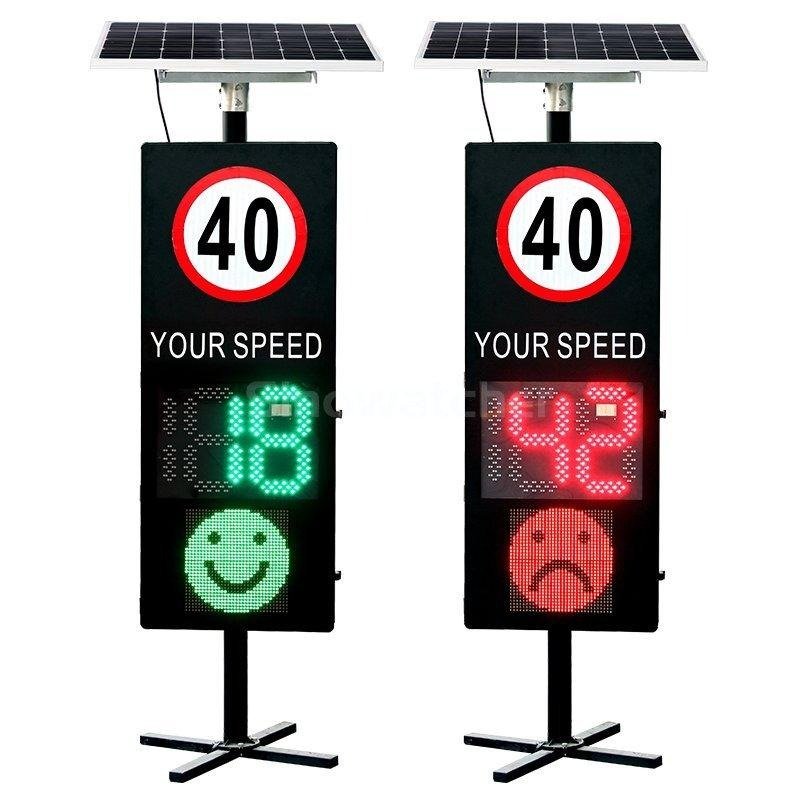
A radar speed sign closes a feedback loop most drivers never notice is open. Many people drift above the limit without realising it, especially on wide roads that feel safe at speed. The sign uses Doppler radar speed detection to measure each approaching vehicle and displays the result on a bright LED speed display. Face-feedback models show a smiling face under the limit and a warning face over it, while green means a safe speed and red means overspeed.
- Doppler radar measures each approaching vehicle’s speed in real time.
- The LED display shows the driver’s actual speed.
- Green and red make safe and unsafe speeds instantly readable.
- Face-feedback models smile for compliant drivers and warn speeders.
Calmer Streets Are Healthier Streets
The health benefits of slower traffic extend beyond crash statistics. Slower streets are quieter, and long-term road noise is linked to stress, disturbed sleep and cardiovascular strain. Slower traffic also means less stop-start driving, cutting exhaust emissions and the fine particles that worsen asthma. When a street feels safe, walking and cycling rise, children play outside, and older residents stay active.
- Slower traffic means less road noise and better sleep.
- Smoother driving reduces exhaust emissions and airborne particles.
- Safer streets encourage walking and cycling.
- Calmer roads strengthen neighbourhood life and wellbeing.
See also: What Separates the Best Technographic Data Providers From Basic Tech-Stack Scrapers
Choosing and Placing Signs for the Greatest Public Health Gain
Placement is where public health thinking pays off. The highest-value locations are where vulnerable people meet fast traffic: school zones, hospital approaches, parks and residential cut-throughs. A solar radar speed sign runs on a panel with a battery backup that keeps it working 7 to 10 days through rainy weather, so it works where no mains power exists. Weekday and weekend scheduling lets a council run the sign when it matters most, while speed data logging shows planners when and where speeding happens.
- Prioritise school zones, hospitals, parks and residential streets.
- Place signs on approaches so drivers slow before reaching people.
- Use solar models where mains power is unavailable.
- Schedule displays for peak risk times, such as school dismissal.
- Use logged speed data to target measures and track progress.
Frequently Asked Questions
Do radar speed signs really reduce crashes?
Yes. The FHWA project found expected total crashes fell about 5 percent overall, and 7 percent in the direction of the sign, with benefits holding after 24 months.
How do radar speed signs help children and older people?
They slow traffic where vulnerable road users are most at risk, giving drivers more time to react and reducing collision severity. Lower speeds also make streets feel safer, encouraging walking and cycling.
Are radar speed signs effective without police enforcement?
Yes. The signs give drivers immediate feedback on their speed, and studies show the effect persists for years without enforcement. They complement enforcement rather than replacing it.
Can a radar speed sign be installed on a road without mains power?
Yes. Solar-powered models run on a panel and battery, and can operate for 7 to 10 days through rainy weather, suiting rural roads and park entrances.
Final Thoughts
Public health is often described as prevention, and few road-safety measures prevent harm as simply as a radar speed sign. The evidence shows real speed and crash reductions, with benefits lasting years. The people who gain most are the ones with the most to lose: children walking to school, older residents crossing their street, and cyclists sharing the road.